

Secondary trading transfers existing ETFT units between participants. Buy and Sell describe these secondary-market transactions. Mint and Redeem describe primary-market creation and redemption. Unless a route explicitly includes a primary operation, a secondary trade does not create units, cancel units, or change the underlying portfolio.

Availability

Alloco-supported secondary trading is available only for ETFTs carrying the Secondary trading label and an active official trading route. An ETFT without this label is not enabled for Alloco-supported secondary buying or selling; use its available Mint and Redeem functions for primary participation. The secondary trading venue and matching model have not yet been selected. Venue details, supported networks, trading pairs, access requirements, fees, and official links will be announced before activation. This documentation does not announce a listing or integration with a particular exchange or protocol. The label indicates product-level availability, not guaranteed liquidity, execution, or continuous access. Always check the current route status. An independently created market does not establish official support.

Primary and secondary transactions

Primary minting accepts USDC or USDT, with USDT automatically converted to USDC before execution. Primary redemption delivers USDC. Secondary trading pairs and settlement assets depend on the enabled venue; primary USDT support does not establish that an ETFT/USDT pool exists. Secondary transactions follow the selected venue’s order, execution, and settlement process. The primary Quote → Processing → Claimable → Completed lifecycle and typical processing estimate do not describe secondary trades.

Premiums and discounts
06 Arbitrage A premium occurs when the secondary-market price per ETFT unit exceeds the identified Product NAV per Unit. A discount occurs when it is lower. Product NAV measures actual attributable assets less liabilities per economic unit; it is not the theoretical Reference Portfolio Value. The comparison identifies which product valuation is used: Both iNAV and Daily Product NAV reflect applicable accrued product fees and recognized product costs. Neither is a guaranteed executable price. Premium/Discount to iNAVt=PtmarketiNAVt−1\mathrm{Premium/Discount\ to\ iNAV}_t =\frac{P_t^{\mathrm{market}}}{iNAV_t}-1 Premium/Discount to Daily NAVt,d=PtmarketNAVddaily−1\mathrm{Premium/Discount\ to\ Daily\ NAV}_{t,d} =\frac{P_t^{\mathrm{market}}}{NAV_d^{\mathrm{daily}}}-1 Here PtmarketP_t^{\mathrm{market}} is the identified secondary-market price per unit at time tt, and NAVddailyNAV_d^{\mathrm{daily}} is the Daily Product NAV for valuation point dd. Multiply the ratio difference by 100 to display a percentage. The denominator must be positive and usable; otherwise, a percentage premium or discount is not presented as meaningful. Reference Portfolio Value is a theoretical performance series and must not be used as the denominator of a product premium or discount. A difference from that reference series is a performance comparison, not a premium or discount to actual Product NAV.

Price basis, currency, and timestamps

A displayed comparison identifies the venue, price basis, market-price timestamp, NAV type, NAV timestamp, and underlying market status. A last trade, midpoint, executable bid, and executable ask can produce different comparisons. A displayed last price or midpoint does not establish an executable price for a particular order size. Compare values in the same currency and per-unit denomination. For a non-USD quote asset, convert the market price using the applicable exchange rate rather than assuming the asset equals one dollar. Do not divide a per-unit market price by total Product Net Assets. Use compatible timestamps where available. If the comparison uses an older Daily Product NAV, label it vs. Last Daily NAV and retain its valuation date and time. A calculation refresh does not make stale underlying prices or accounting records current. A difference from a stale closing valuation is not necessarily executable arbitrage. See Pricing & NAV for the distinction between Reference Portfolio Value, Product NAV, and order-specific pricing.

How primary participation can reduce deviations

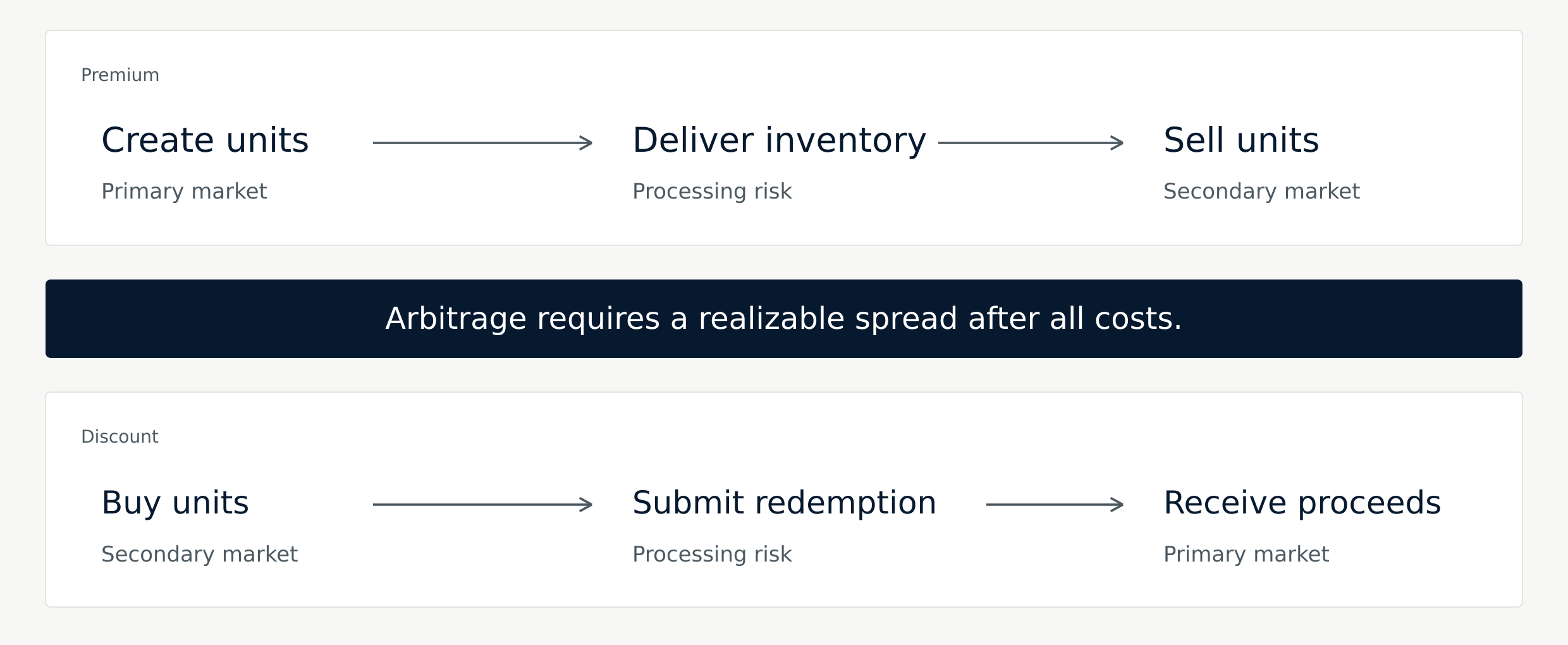
When a realizable secondary sale price exceeds the full cost of minting and delivering units, a participant may mint and then sell. When realizable redemption proceeds exceed the full cost of buying units, a participant may buy and then redeem. These activities can bring market price closer to Product NAV. They depend on eligibility, inventory, liquidity, fees, dealing windows, processing capacity, and price changes while the transaction is processed. They do not guarantee a fixed price or risk-free profit. For an illustrative Product NAV of USD 10 per unit, assume that the underlying entitlement can be established or liquidated at that value before the separately counted aggregate costs, with no intervening market movement or valuation difference. An all-in mint-and-sale cost of USD 0.08 per unit then gives a static breakeven sale price of USD 10.08; a higher price is needed for a positive net result. An all-in purchase-and-redemption cost of USD 0.07 gives a static breakeven purchase price of USD 9.93; a lower price is needed for a positive net result. These are hypothetical aggregate costs, not a fee quote or a promise of execution at Product NAV. An observed premium or discount is not itself an arbitrage profit. Participants assess the Mint / Redeem Quote, its output limits and validity, and the executable secondary price for the intended size. The Final Mint / Redeem Outcome depends on actual execution, conversion, costs, and reconciliation; it may differ from the initial estimate. An arbitrage calculation must include any USDT-to-USDC conversion, any required USDC-to-USD or USD-to-USDC conversion, underlying execution costs, secondary fees, network charges, and the applicable holding-period redemption fee. Costs already reflected in actual fills, net conversion amounts, or Product NAV must not be deducted again as the same cost. Buying in the secondary market does not itself waive the redemption fee.

Trading outside underlying market hours

Depending on its operating model, a secondary venue may remain tradable while the underlying securities market is closed. Liquidity providers then bear inventory and price-discovery risk, and spreads or deviations from the last available iNAV or Daily Product NAV can increase. The displayed comparison must identify the valuation used and its timestamp; an older valuation is not a current executable price. A live blockchain does not make underlying assets continuously redeemable. Use only the official venue links, market identifiers, and any applicable contract addresses published for each enabled product. Independent venues can have different liquidity, fees, supported assets, and risks.