

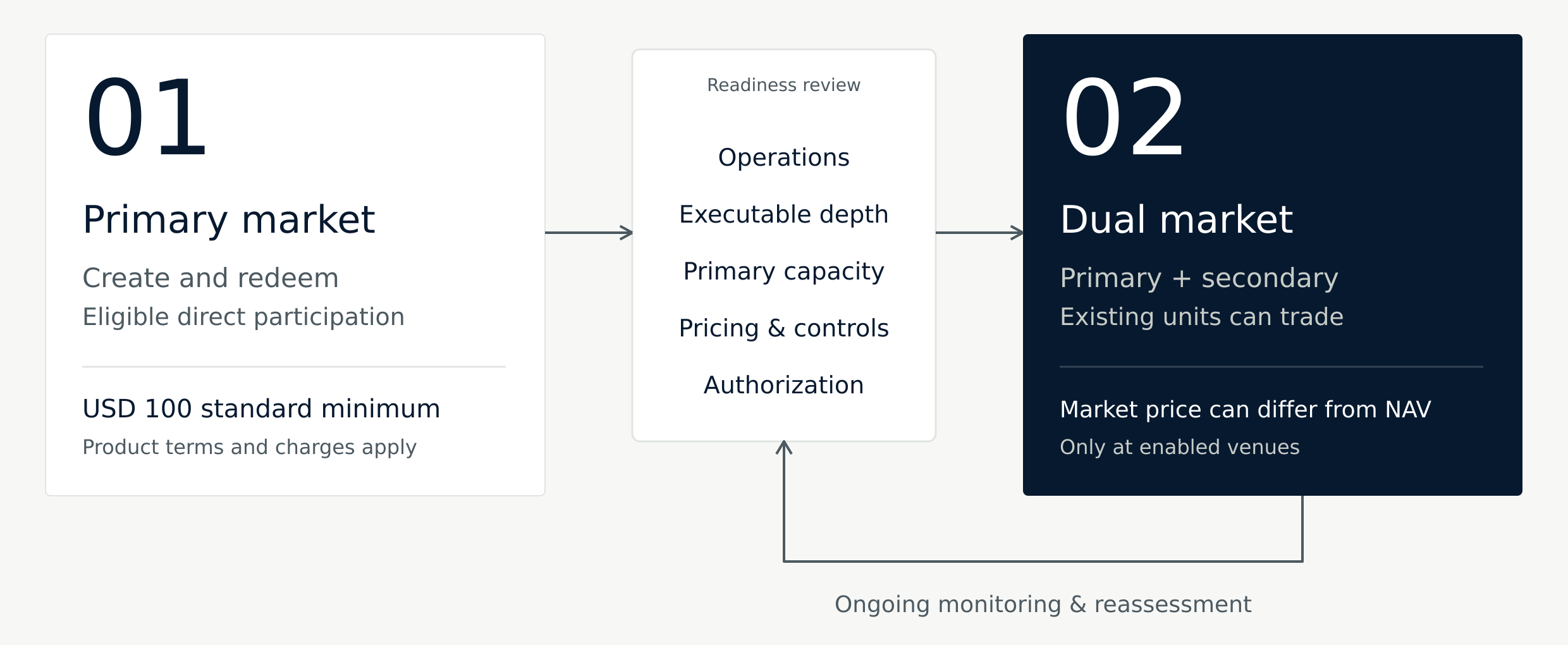
Stage 1: Primary market
Eligible participants transact through the issuance mechanism. They contribute supported assets to create units or redeem units for the applicable proceeds. The standard minimum creation amount is USDC 100 equivalent. Each product and order screen states its supported settlement assets and any different minimum. Primary participation is open to eligible users rather than reserved solely for investment banks or large broker-dealers. This does not remove jurisdiction, identity, product, wallet, or transfer requirements, and does not confer traditional ETF authorized participant status. Before an official secondary venue is enabled, redemption is the principal product-supported exit route. Token transferability alone does not establish a liquid market.Stage 2: Primary and secondary markets
An enabled secondary venue allows participants to buy and sell existing ETFT units. Primary creation and redemption remain available under the product’s dealing terms and provide a mechanism for adjusting supply. Secondary trading does not guarantee continuous liquidity or execution at NAV.Readiness review
Secondary access is assessed at the product level across five dimensions:| Requirement | What the review establishes |
|---|---|
| Operational integrity | Creation, redemption, unit accounting, and reconciliation operate consistently |
| Executable liquidity | The pool or venue can support the intended order sizes at acceptable transaction costs |
| Primary capacity | Creation and redemption capacity is appropriate for the intended secondary market |
| Pricing and controls | NAV inputs, stale-price handling, incident procedures, and contract controls are in place |
| Product authorization | The venue and transfer model are consistent with the product’s governing terms |